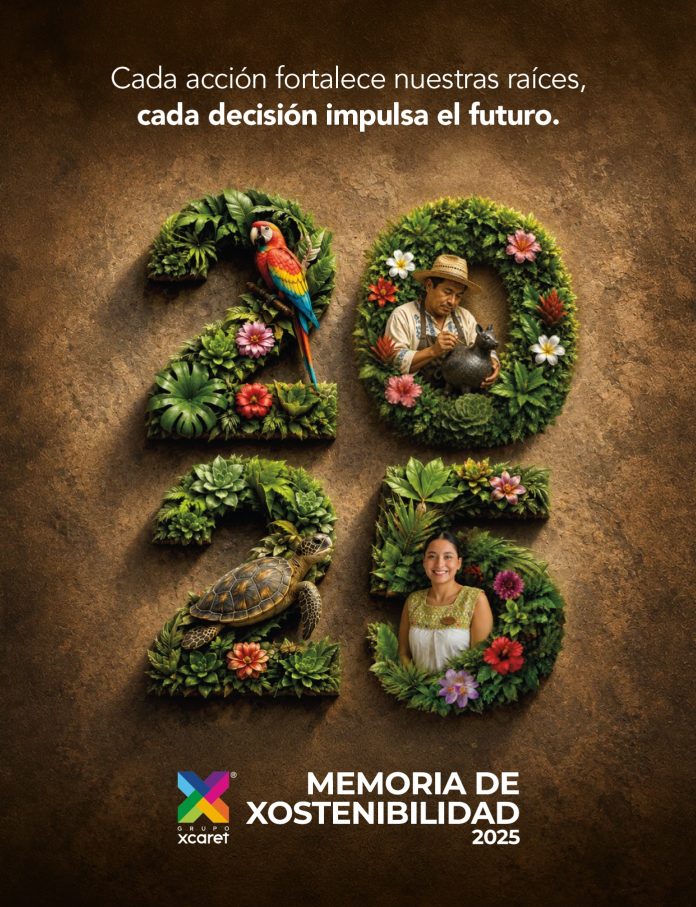
The 2025 Sustainability Report compiles the results of a year defined by historic investment, biodiversity conservation, and the strengthening of communities and Mexican talent.
A workforce of over 18,000 employees, 90% of procurement sourced from Mexican suppliers, and 20 million sea turtle hatchlings released since 1996 reflect the scope of the model.
Xcaret, Riviera Maya, August 20, 2026. Tourism faces one of the greatest challenges in its history: continuing to grow while minimizing the impact on natural resources and preserving the cultural identity and well-being of the communities that make each destination possible. Against this backdrop, Grupo Xcaret presents its 2025 Sustainability Report, a document demonstrating how a business model can generate economic, social, and environmental value with transparency.
During the year, the organization announced an investment of over $1 billion—primarily for the expansion of Hotel Xcaret México, which reached 1,800 rooms and obtained EDGE and EarthCheck certifications—thereby strengthening the Mexican Caribbean’s tourism infrastructure based on sustainability criteria and driving the region’s economic development.

The company’s performance in environmental, social, and governance (ESG) matters was recognized by the Merco Mexico ESG 2025 ranking, which named it the number one company for ESG reputation within the country’s hotel and tourism services sector. This leadership is underpinned by the company’s daily conservation efforts: it operates over 5,000 solar panels—generating 4.04 million kWh of clean energy and avoiding the emission of 1,796 tons of CO₂—reforested 275,273 native and endangered plants, and maintains eight partnerships with specialized conservation institutions. Furthermore, the Sea Turtle Conservation Program celebrated three decades of work, having successfully returned more than 20 million live hatchlings to the sea. This same logic of shared growth is reflected in the group’s economic and social impact. It welcomed over 5 million visitors, guests, partners, and passengers; sourced 90% of its purchases from suppliers based in Mexico; and worked with 184 suppliers from rural communities and 3,574 suppliers affiliated with NAFIN, thereby strengthening local supply chains.
People are at the heart of Grupo Xcaret—a community of over 16,000 employees. During this period, 85% of the workforce received training on the Code of Ethical Conduct, resulting in zero confirmed cases of corruption throughout the year. Furthermore, the company reaffirmed its commitment to social well-being by awarding 493 scholarships to the children of its employees.
In the community sphere, notable investments include $2.7 million in the Kone’ex Xiimbal program and $4.25 million in Social Tourism. These initiatives bring tourism and cultural experiences to Mayan communities through free visits to Xcaret Park, complete with transportation, meals, and service provided in their native language.

“Every day, in every park, hotel, and community where we operate, we strive to ensure our work holds meaning beyond the business itself—whether on the beach where we release sea turtles, in the workshops where master artisans keep Mexican culture alive, among the families that make up our team, or in every experience shared with our visitors. This Sustainability Report bears witness to a specific way of doing tourism—one we have been building for over three decades,” noted Miriam Alonso, Deputy Director of Sustainability at Grupo Xcaret.
The report aims to contribute evidence to a conversation of growing importance within the hospitality and tourism industry: how to generate economic growth while protecting the very qualities that make destinations unique. For Grupo Xcaret, therefore, sustainability is not merely an add-on initiative; it is the guiding principle behind the evolution of its business model and its purpose—to make the planet happier by sharing its profound love for Mexico.